
In my last blog to you we talked about navigating going back to school. How’s it going, darling? Is your child thriving with an incredible teacher? Or, after a month of school are you (and your kiddo) ready to call it quits? Wherever you are in your education journey this fall, my hope is you believe you and your child deserve the absolute best. And, if your child’s school environment is not working, you are finding your way to advocate for their needs. No matter what you are experiencing I believe that you and your child deserve peace and support. I’ve got you, and you’ve got you.
Outside of the school system there are dozens of suggestions for making our children’s lives better. When your child is neurodiverse or learns differently, at times it can be overwhelming to know what strategy or intervention works best. That is one of the many reasons I’m in love with ABA; it’s idiosyncratic. Or in other words each intervention is built specifically for your child (or should be Big Box ABA…). That being said, there are tools that can be helpful for a lot of children. One of my very favorites to recommend is the use of visuals.
Thinking Visually
Years ago when I was learning about ABA I came across Temple Grandin and her book “Thinking in Pictures”. In this memoir Temple writes about how her mind thinks with pictures and not words. While not all autistic people think visually before they think with language, it gave me insight into testing language when I was learning to practice ABA. As a young BCBA I spent time testing what we call receptive language (what we hear) and expressive language (what we say). In my work I used many different tools to test language, pictures being one of them.
In my time as a practicing BCBA I found that each learner of course tested differently. However, the most impactful to me was working with autistic adults who did not have access to ABA as children. These adults were brilliant and wonderful. And, because no one had taught them how to use language, the individuals I was working with were very limited in their language. That’s not to say all neurodiverse adults present this way without ABA. It was the population I was working with who did not learn language naturally and were stuck in their language abilities.
Before my time with these adults I had thought I wanted to work in early intervention. When I met these beautiful people, I knew I wanted to help anyone I could who needed access to ABA. There are several clients who stay with me; Aubrey was one of those who changed my life.
An Incredible Story
Aubrey was a young autistic man who worked at a warehouse in the packing department. Aubrey was kind, gentle, and hardworking. Until Aubrey was not and became extremely physically violent at work. I was called in for the crisis and began my work with Aubrey. The first test I completed was of course language; problem behaviors are communication so I wanted to see what Aubrey was trying to say. In my testing I pulled out a series of pictures. Aubrey pulled the binder to him with tears running down his face and snatched a shoe picture. He pointed to his own feet, then shoved the picture to me. I bent down to remove his shoes and saw blisters everywhere. Aubrey’s group home put him in the wrong shoe size, he didn’t have a way to tell them, and his feet hurt. After a day of shoe shopping and a binder full of pictures for his needs, Aubrey’s life changed. The aggression was gone (along with the pain) and Aubrey was back to himself.
Finding Voice
While this story is unique, the principle is not. Individuals with autism can think in pictures before language and so having visual aides and pictures gives them access to our social world. Often autistic children who think in pictures do not know what we call the things they see. ABA therapy (and parents) can build their understanding of our social world by teaching them, one picture at a time, the labels of the pictures they see. Once a child knows what an item is called, they learn how to ask for it. It’s a beautiful thing to watch and build – turning pictures into words. And words into meaning.
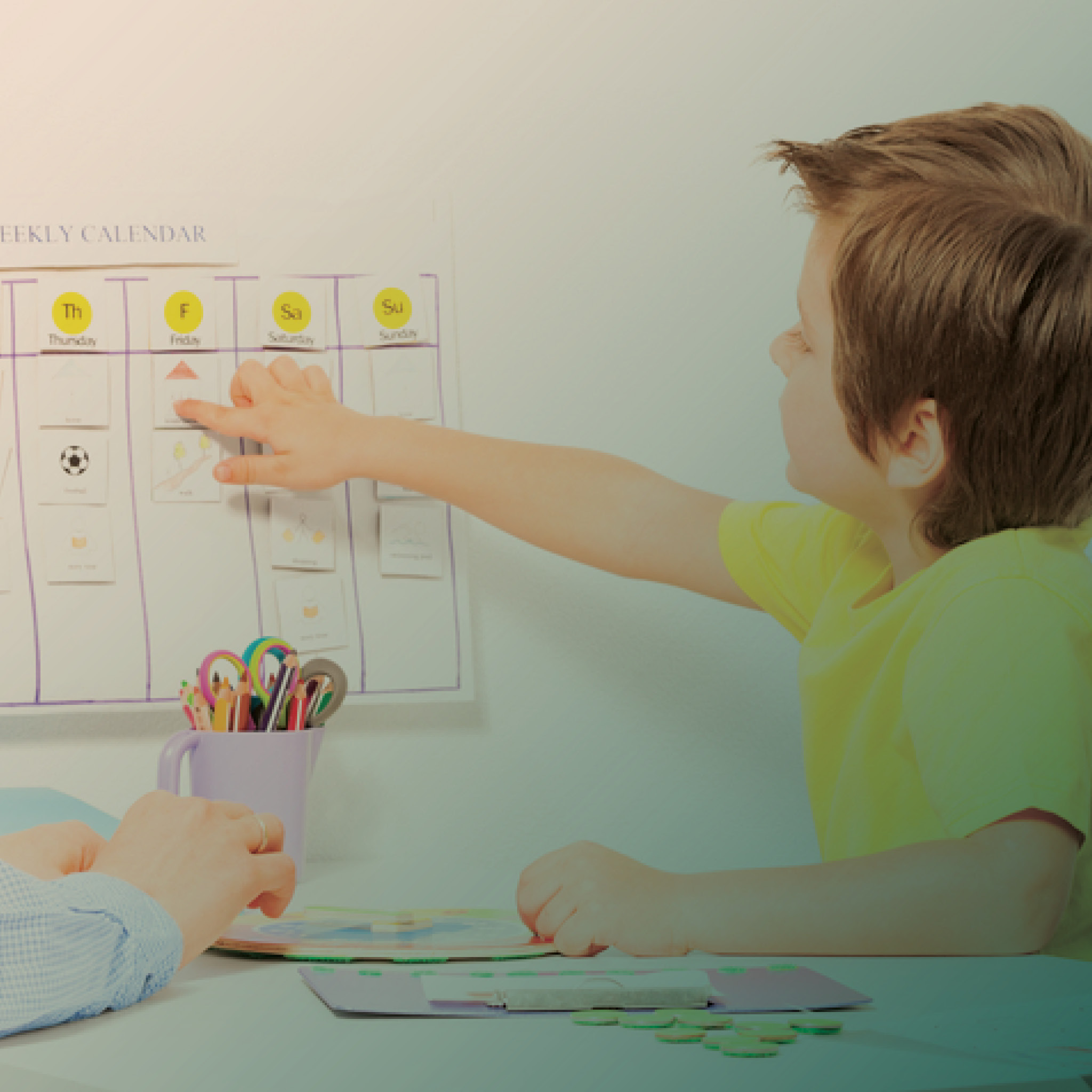
Outside of using visuals for language, parents can also use visuals to simply explain the day. Calendars and visual schedules can remind children what is coming next and help to reduce anxiety. I’ve been divorced for 5 years and for 5 years I have made a monthly calendar for my boys to know where they will be. Today is the first day of October and as I packed little Spidermans on the bus (no, it’s not costume day…) my youngest reminded me to make our calendar. It’s peaceful for them to see their world visually. It can bring peace for all children (and ourselves) to know what is coming next.
So, my darlings, as you digest my words to you, I hope to leave you with this. Not all tools are created equally and language in a social world is a powerful tool. Being able to understand our social world, how to ask for our needs, and knowing what is coming next is calming for all of us. If you are the parent of a neurodiverse child, pictures just might be the tool they need to express themselves. And, if they can verbally express themselves, pictures could also be the tool you use to explain the routines of their lives. However you choose to experiment with pictures, my hope is it adds value to your child’s life. And I’m hoping you’re still smiling a little for Aubrey.
Xoxo,
Jessie Cooper